Euclid's Equality
Applying the dictionary to DEI

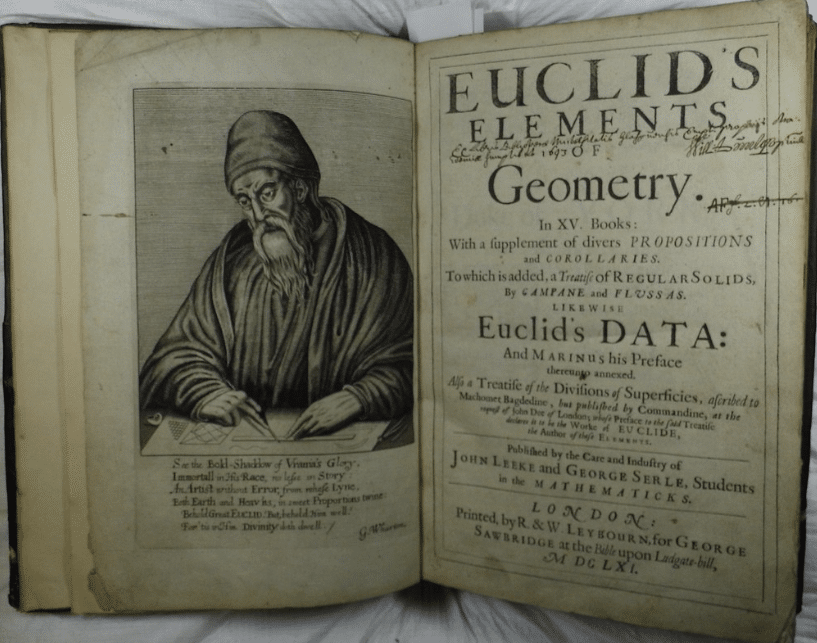
There’s a major contradiction at the heart of one of the most widely promoted post-modern frameworks in contemporary public life - DEI - and it requires only a dictionary to find it.
Among Euclid’s foundational axioms is a deceptively simple proposition: things which are equal to the same thing are equal to each other.
If A = B and B = C, then C = A
The power of this axiom lies in what it demands of language. Equal means equal: identical in the relevant measure. And if two things are identical in the relevant measure, they are not diverse in that measure. They cannot be. Diversity means difference. Things that are equal are not different. Things that are different are not equal.
It’s a grammatical certainty; no matter how much we would like it not to be true, it is so. The contradiction was present before anyone opened their mouth. This is how language works
Imagine a student proposing to Euclid that a set of things might be simultaneously diverse and equal: different in nature but identical in value. Euclid puts down his stylus. Very slowly. He frowns. His method does not permit this. You begin with only what can be demonstrated and follow it wherever it leads, even when the destination is inconvenient. If A is genuinely diverse from B, they differ in some relevant respect. And if they differ in some relevant respect, they are not equal in that respect. You may declare them equal by fiat, or by insistence or by lie. But you cannot make them equal by logic. The axioms do not bend; they are intolerant, and need to be.
People are genuinely diverse: in aptitude, inclination, temperament, interest, height, shoe-size, IQ. Then genuine freedom at the level of the individual will produce unequal outcomes. This is genuine natural diversity; it is what diversity looks like in practice. To then enforce equal outcomes requires actively managing the diversity that produced the unequal distribution: selecting for, selecting against, constraining, correcting.
How did this pairing survive long enough to become a global institutional framework? Because the words were never being used precisely. Lifted from the dictionary and placed into a register where they function not as terms with meanings to be tested, but as signals of moral allegiance. In that register the contradiction is invisible, because no one is analysing meaning; they are performing.
Euclid would have been firm. You cannot build a coherent system of anything on a contradiction at the foundation. If the axiom does not hold, you do not have a different geometry, you have no geometry. You have words arranged to feel like reasoning, which is a different thing entirely.
I still remember coming across Euclid's Elements on my father's shelves (abridged student edition). It was a revelation! And a spur for further reflection: An axiom might be 'self-evidently' true, but why is that fact obvious? What makes truth 'truthful'? It was also the first time I became aware that truth-statements might be 'simple' when stated, but were far from obvious until someone made you aware of it (if you get my meaning).
As for your point above, it is very good (and obvious, once you explain it so clearly :-)
Problem is, the morons aren't interested in truth, logic or reason -- they're playing a tedious social game of moralistic one-upmanship on a rhetorical level, and they're not clever enough to realize the consequences even if it gang-rapes them on the church steps or bankrupts their polity.
I walked away from that game many years ago. I play my own game.