Ein Geschichte

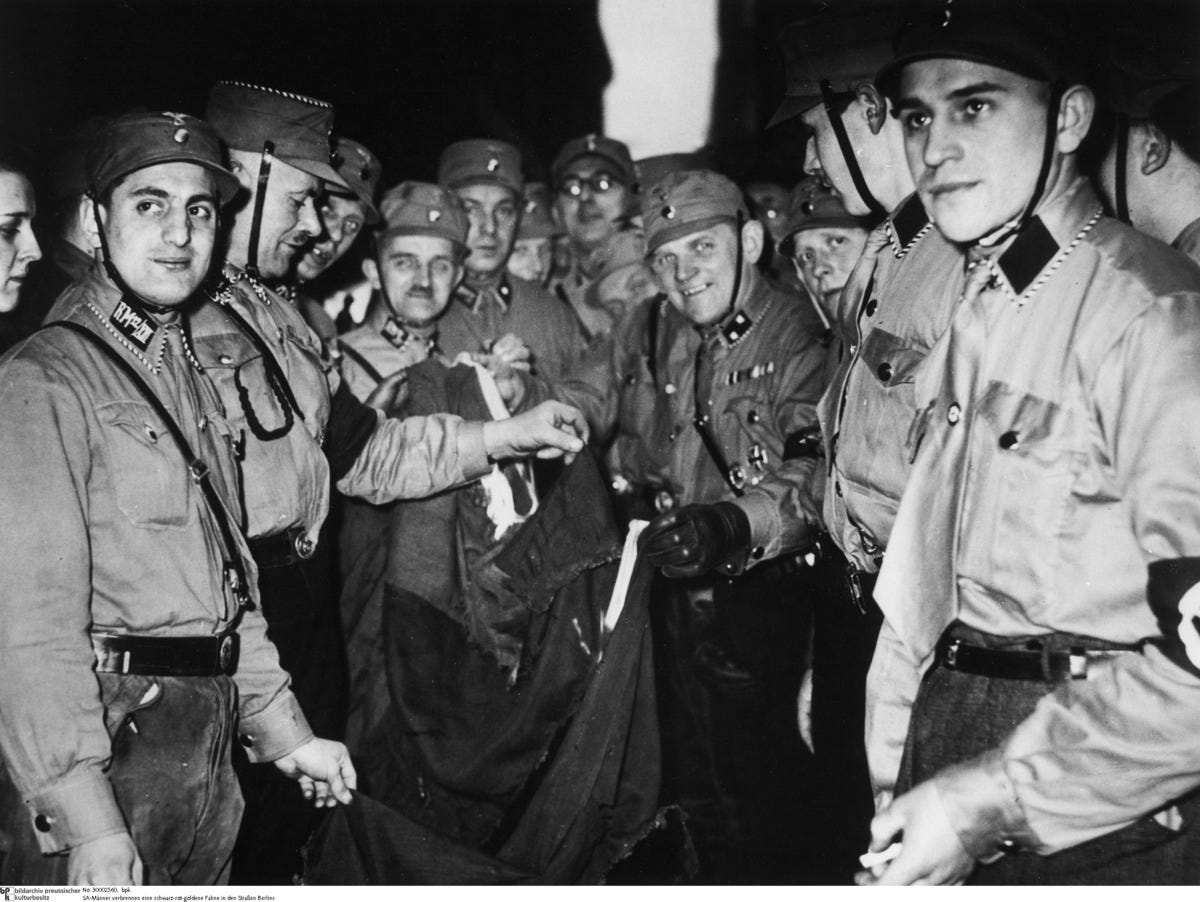
Reinhardt had been at the SA’s Hauptquartier most of the day, attempting to reduce the height of a stack of papers and forms which, despite his efforts, seemed every day to remain at the same height.
By late afternoon he’d had enough and glancing at his watch, he was reminded that he had ordered his Truppführer to order their Scharführer to order in turn their Rottenführer to make sure that their Männer were assembled in the yard at the front of the Rasselstein Steelworks at eighteen-thirty.
He set off intending to walk the distance to the steelworks, leaving an elderly janitor poking at a radiator in the hall which had been leaking black rusty water into large pools for days.
‘Are you going to be able to fix that today?’ he asked the janitor, just before leaving and not waiting for an answer.
The flags were out that day. Everywhere. It seemed to Reinhardt as though from every window of every house and apartment and in every street, the national flag of the Reich – the red flag with a white disc containing a black swastika, had been hung out. Of course, it was so. The Hausmeister of every apartment block and of every district had made sure it was so. No one wanted to be reported to the police; to the Gestapo.
In the town centre, loudspeakers attached high on lamp posts blared out recorded speeches of either Hitler’s or Goebbels’ or of some other of the Party cabal. The townsfolk went about their business oblivious. Good Germans though they were, they’d heard it all before. Mischievous young boys took childish delight in shimmying up the lampposts to stuff crumpled-up newspaper in the horns of the loudspeakers to distort sound of the monotonous broadcasts. Everyone chastised the boys of course - for show - yet secretly hiding their smiles at such irreverent foolishness.
People nodded or waved to Reinhardt as he walked through the town. Some saluted, and Reinhardt saluted back. There was a definite atmosphere of wellbeing amongst the townsfolk. Reinhardt could feel it.
In their recent memories they’d been defeated in war and humiliated by the ensuing peace. They’d had to accept onerous reparations exacted upon them by the victors. Unemployment had been high. Men, old and young, loitered and menaced the streets. Their society had been torn apart by riots and fighting between the communist organisations and those who opposed them. Demobilised soldiers who could not get work had eagerly joined the Party as bully boys and had relished the opportunities to fight. They’d seen their economy descend into chaos: those who possessed Reichmarks discovered that their notes had become worthless.
All that had gone, now. Their Führer had fixed things. He had fulfilled his promises. He brought jobs and a new prosperity. He gave the Volk a new purpose, a new belief in themselves and in their country. He gave them a reason to be proud again – to be proud of being German. So what if they had to endure endless speeches broadcast incessantly. So what if they had to fly a few flags now and again and salute constantly, and so what if they had to follow a few rules.
Their Führer had built a winning party. He’d created an organisation, the one Reinhardt was a member of, which gave thousands of young unemployed men brotherhood, status, self-respect, and money in their pockets. So what if they had to rough up a few communists now and again. So what if they had to beat up a few people here and there.
Life was good. And for everyone. And they knew it. The country was back on its feet. Respected. Feared. People could afford a few of the finer things in life. They could see it; Reinhardt could see it directly, as he walked past a shiny new Volkswagen Peoples Car, parked outside the Town Hall. His father had joined a scheme the previous year at work to save for one. Just a few years before this would have been beyond a dream, yet Adolf Hitler had made the dream a reality.
That day, they’d all dressed in their Sunday best. The men had had their best suits pressed; they’d starched the button-on collars of their shirts. They’d polished their boots to a reflective shine. The women had looked out their best dresses and dusted down their finest hats. They all just had to look their best.
The sun shone brightly. Mothers chastised their children, hoping to keep their clothes free from dirt and their knees free from grazes, and wagged their fingers when they caught their husbands drinking from their not-at-all secret hipflasks they had hidden in their coat pockets.
It was a perfect day for a national holiday. It was. A perfect day for a birthday.
That day was the Führer’s birthday. Everyone was out and about, and everyone was smiling. Everyone that is, except the Jews. They were unerwünscht. They were not welcome.
Just a few decades before, no one in the town had given a second thought about who was who or who had come from where. In the eighteenth century the town had become known across Germany for its religious tolerance - unlike in the rest of the Palatinate. Much immigration to the town followed, as word spread of its reputation, of numerous religious refugees from other German territories. But also, from France and Switzerland. Later in the nineteenth century another wave of immigrants came, seeking work in the burgeoning steel works.
Back then, no one gave a damn. But they gave a damn now. They gave a damn now about Jews.
Dr. Shlomo Silbermann had been a popular and well-respected medical doctor, well known for his expertise throughout the region, though he was no longer allowed to practice medicine. At least not with Germans. He’d been a visiting professor at the Festungslazarett Koblenz, and the Katholisches Klinik in Koblenz-Montabauer, where medicine was taught, though he was no longer allowed to teach there, either. And nowhere could he practice medicine on Germans.
He made a living now from the few hundred Jews who had either chosen to stay in the town or who perhaps had nowhere else to go. Before, everyone – Jews and Germans alike - had thought that he was a fine doctor and an effective teacher, until they had been convinced that he wasn’t. He was lucky if he spent a day without the youngsters in the town taunting him and spitting at him. ‘Jude, Jude,’ they’d scream.
Then there was Heinz Guggenheim. He was a successful Rechtsanwalt in the town – or rather, he used to be. No one needed legal advice or representation any longer, leastways not from a Jew. He had been respected and liked by his clients and feared by other advocates, for his sharp mind and, when required, his whip-like wit. He’d been a war-hero during the Great War and in his office, on display, for all to see in a glass case – or, so that they would see, was his Eisener Kreuz when, as an Unteroffizier on the Western Front at Passchendaele, he’d charged a British machine gun emplacement and, alone, destroyed it. He was extremely proud of it. Everyone admired it. He had saved four of his wounded Kameraden from death and had taken a bullet in his thigh, which though fully healed left him with a slight drag of his left foot. He relished the chance to retell his story, and everyone genuinely enjoyed listening, though many had heard it many times over and with each telling there’d be a new embellishment. He claimed, somewhat disingenuously, that it had been presented to him by the Kaiser during his recuperation in the Kriegslazarett. None believed him but they pretended they did. He didn’t mind and it made everyone laugh.
That Germany was a faraway place these days.
The Jews kept themselves to themselves. They kept their heads down and ventured out into the town only when they had to - to the Synagogue or to their well-stocked Kosher shops. Of course, they were well stocked, the German wholesalers supplied them - business was business, after all, and the wholesale prices were constantly being raised. It was rumoured that the wholesalers bought non-kosher goods on the black-market for supply to the Jews. Business was business, after all.
When Reinhardt arrived at the steelworks, his Männer were there in the large, gravelled forecourt in front of Rasselstein’s recently built offices: a grey stone-faced concrete building of four storeys in an angular monumental style which seemed slightly out of place and embarrassed at its own prominence.
They were all milling about, talking, smoking, and drinking beer from bottles. Someone had set up a trestle table on which two crates of the local Weissenthurmer beer had been placed. Reinhardt, the local Gauleiter and Gehrt exchanged the usual salutes and formalities. And then to Gehrt, his senior Truppführer, ‘Have the men line up.’
Gehrt barked off an order that had his men dropping cigarettes and running first to place their bottles onto the trestle and then to get into position. Reinhardt gave a short speech about discipline, staying in good marching order, not letting him down, and the like.
Dusk was falling. Each of the 60-odd men were given either a torch or a party banner to carry.
‘Do not light your torches until I tell you,’ shouted Gehrt.
Reinhardt and the Gauleiter were to march in front of the procession. Gehrt was to march behind them, carrying a red banner proclaiming the insignia of Reinhardt’s Trupp, replete with oakleaves and swastikas.
The whole Trupp was split, half were to march in front of the town’s brass band and half were to march behind. And behind them all, the men from the Feuerwehr would march, and at the rear, townsfolk joined in.
Reinhardt checked the time on his Wempe wristwatch. Two minutes to seven. ‘Positions,’ he called to Gehrt.
‘Light the torches,’ screamed Gehrt. He waited until he could see that all were lit. ‘On my command……..im Gleichschritt……..Marsch.’
The column set off in good order, not a step out of place. Even the marching band and the Feuerwehr had got it right. Many townsfolk had joined at the rear. They were all out of step, of course, and they were smiling and cheering. The band began to play something appropriate for a military style march.
They moved out of the yard. Marching south and west following the road into Neuwied town, proper. As they marched closer to the town, onlookers lining the road and then the streets became more numerous. People waved, children held flags, and fathers held their smaller children aloft to sit on their shoulders. They all gave the obligatory salute when the head of the procession went by. Children ran alongside the SA Männer. Many adults marched alongside too, trying to keep in step.
It was dark now. The march continued past the Schloß on their right, by the Rhein. The band played, appropriately, a familiar marching song, ‘Die Wacht am Rhein’ and the whole Trupp joined in as did many of the onlookers.
Es braust ein Ruf, wie Donnerhall,
…
And so, it went on. All the way into the town’s centre.
Further on, they marched past the town’s Synagogue. It was an older building now defaced with a hastily daubed Star of David. The procession passed several shops. A few were boarded up; their proprietors having left, though their names were still visible above the boards; Lachmann – Watchmaker; Silberberg and Rosenthal – Klavier; Löbmann und Söhne - Luggage – all witnesses of a once thoroughly integrated Jewish section of the town’s commercial class. Scrawled on the shop windows, doors, and fronts, were Stars of David or ‘Juden’ and ‘Hier kaufen Deutsche nicht!’. Some shops had remained open - optimists hoping for the best. But what else could they do?
Everywhere in the town centre, beer tents and stalls selling bratwurst, schaschlik, and raw herring in bread rolls, had been set up. There was a children’s fair with a merry-go-round and other rides. Erika – a popular marching song – was playing through the loudspeakers mounted on the lamp posts but was gradually downed-out by the approaching band. No one had remembered to turn the music off.
Otto and Irma were there, stood on the kerbside, outside the well-dressed display windows of a subsidiary store of the new Kaufhof chain. It wasn’t new, of course. The company had been forcibly taken over from the Jewish Tietze family some years before.
Otto had dressed up in his best grey flannel suit and a black, woollen double-breasted overcoat. He tapped his foot in time with the music. Irma too had dressed for the occasion, even donning her fake fox stole, which Otto had bought her many years before. She waited to see Reinhardt, her son. Irma stood with her arm hooked into Otto’s left arm – his hand in his overcoat pocket. In his right he smoked a cigarette in his gloved hand.
‘Otto, look, look! There he is.’ She cried and clutched her husband’s arm.
She called above the clamour and the band, ‘Renzi Schatz, Renzi!’ She waved.
Reinhardt looked straight ahead as he marched past, receding further into town. Irma’s. hand remained aloft for a few moments, then she lowered it clutching her handkerchief, though her smile remained, still watching her son walk away.
Otto overheard one onlooker - a tall, well-to-do man in an astrakhan overcoat with a black Homburg and round tortoiseshell spectacles - not more than a metre or so away from Otto, say to his wife. ‘Look at them. Just a few years ago they were all layabouts and ruffians. All of them, Nichtskönner. Now look, strutting like peacocks acting like they own the place.’
Irma did not notice as Otto slipped away. Moments later Otto returned to Irma’s side. A minute after, Otto glanced over his shoulder as two policemen approached the man in the Homburg and astrakhan coat. He and his wife were politely and quietly escorted away. No one saw a thing or if they did they pretended they hadn’t.
The procession ended. The band continued to play, and everyone applauded until they began to disperse into the fair or to the stalls or into the bars and restaurants. The SA Männer went straight to the beer tents or into the local Kneipen. The beer and Schnapps began to flow.
Reminds me of Pride Month.
A very peculiar historical fiction. The end is abrupt, of course, i understand why: the normalization of everything in the story had to end in a sort of irrelevance, an established zeitgeist.
You would definitely enjoy Laurent Binet’s novel « HHhH », which deservedly won the Goncourt award. Do u read french as well as german? The 4 letters of the title is the acrostic of « Himmler’s Hirn heist Heydrich. »